



Charitable Remainder Trust for Real Estate: The Full Guide

How to Sell Your Real Estate with a CRT
Selling a property that’s appreciated for years can come with a hefty tax bill—often more than a third of your gain once federal & state taxes add up. A Charitable Remainder Trust for real estate can help you defer taxes.
A Charitable Remainder Trust lets you sell property inside a tax-exempt trust, reinvest 100% of the proceeds, take an upfront tax deduction, and receive cash distributions for life or a set term.
Below, we’ll walk through how a Charitable Remainder Trust works for real estate, the steps to sell, two real-world examples, and the rules to watch out for.
What Is a Charitable Remainder Trust for Real Estate?
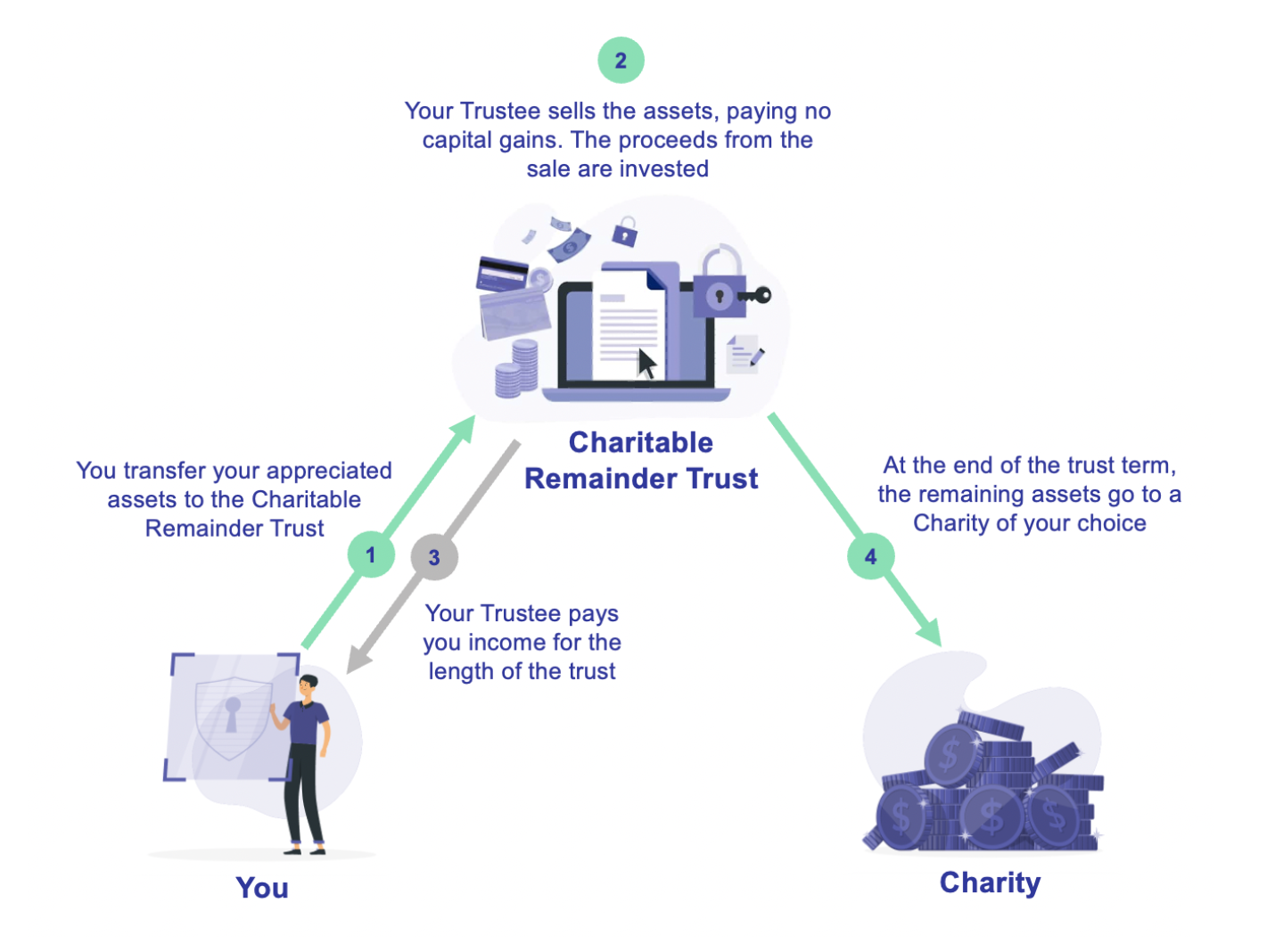
A Charitable Remainder Trust (CRT) is an irrevocable, tax-exempt trust into which you can contribute an appreciated asset like real estate and the trust can sell it without paying capital-gains taxes.
The trust pays you (and any other beneficiaries you name) cash distributions for life or for a term of up to 20 years; whatever remains at the end goes to charities you choose. Per the IRS, that remainder must be worth at least 10% of the property’s value when you contribute it.
Think of it like an IRA for appreciated assets: your money compounds tax-deferred and you pay tax only as you take distributions.
There are two main types of CRTs. A Charitable Remainder Annuity Trust (CRAT) pays a fixed dollar amount, starting right away, even if your property hasn’t sold yet. A Charitable Remainder Unitrust (CRUT) pays a fixed percentage (5–50%) of the trust’s value, recalculated every year.
Should You Use a CRAT or a CRUT for Real Estate?
For real estate, a CRUT is usually the better fit (see our CRAT vs. CRUT comparison). Because CRUT payouts are recalculated each year, they can grow as the reinvested proceeds from the real-estate sale grow, resulting in more money for you, while CRAT distributions stay fixed, based strictly on the initial value of the property asset when first contributed.
There are three types of CRUTs that can handle a property that takes time to sell:
- Standard CRUT: pays a set percentage of the trust’s assets every year.
- NIMCRUT: pays the lesser of the trust’s net income or the set percentage, with makeup payments later.
- Flip CRUT: starts as a NIMCRUT and “flips” to a standard CRUT after a triggering event, like the sale of your property.
Why Use a CRT for Real Estate?
Here’s what a Charitable Remainder Trust can do when you sell real estate:
1. Defer Capital-Gains Taxes on the Sale
Because the trust is tax-exempt, it owes no federal or state capital-gains taxes when it sells your property. Instead of losing a third or more of your gain upfront, you reinvest the full proceeds and pay tax gradually, only as you receive distribution payouts. Spreading that income over many years can also keep you in lower brackets (i.e., “tax-smoothing”).
2. Get an Upfront Charitable Tax Deduction
You’ll get an immediate income-tax deduction for the present value of the charity’s remainder, typically about 10% of the property’s value. See how it’s calculated in our guide to the Charitable Remainder Trust tax deduction.
3. Diversify Out of Real Estate
Unlike a 1031 exchange, a CRT doesn’t require you to buy another property. In fact, there are a variety of investment strategies for Charitable Remainder Trusts for reinvesting in stocks, bonds, funds, and more.
4. Turn Property into Reliable Income
Swap a building you have to manage for a stream of payouts in the form of annual cash distributions for life or a set term—no tenants or repairs required.
5. Support Causes You Care About
What’s left in the Charitable Remainder Trust at the end of its term (the “remainder”) goes to the charities you choose so you can create a meaningful legacy. Still, Charitable Remainder Trusts almost always generate net profits for people, even after factoring the charity donations as an expense; see how in our case studies below!
How to Sell Real Estate with a Charitable Remainder Trust
When it comes to selling real estate with a Charitable Remainder Trust, timing is everything: you must contribute your property as an asset to the CRT before it’s sold. Technically, you forfeit ownership of your real estate when it’s in a CRT, but you can retain control of the asset.
Here’s the typical process for selling real estate with a CRT:
1. Compare Your Options
There are different ways to avoid capital-gains tax on real estate, each with its own pros & cons. As a first step for due diligence’s sake, check that a Charitable Remainder Trust, and specifically a CRUT, is the best fit for you.
2. Set Up Your CRUT
Choose the trust type, term (life or up to 20 years), payout rate, and charitable beneficiaries.
With Valur, setup can happen in one business day and with no upfront costs (see what a Charitable Remainder Trust costs in general, such as paying an attorney to do the setup for you, to understand how much you can save with Valur instead).
3. Address Any Mortgage
Property debt can create tax problems when an asset is in a Charitable Remainder Trust, so most owners pay off the mortgage before contributing real estate to a CRT.
4. Get a Qualified Appraisal
You’ll need a qualified appraisal of the property to support your charitable deduction.
5. Deed the Property to the Trust
Transfer title to the CRT before signing a binding sales contract. If you’ve already agreed to sell, the IRS can treat the gain as yours.
6. Have the Trustee Sell the Property
The trustee, which can be you, directs the sale. The buyer can be almost anyone except you, your family members, or certain other disqualified persons, such as the trustee if that’s not you.
7. Reinvest and Start Receiving Payouts
The trust reinvests the full proceeds and your payouts begin according to the trust’s terms.
Case Studies of Charitable Remainder Trusts for Real Estate
Case Study #1: Selling a $2.25-Million Apartment in N.Y.C. with a CRT
Michael, who lives in New York City, bought an apartment for about $250,000. Years later, it’s now worth around $2.25 million and he’s ready to diversify.
If he sells outright, Michael owes about $480,000 in federal capital-gains taxes plus about $270,000 to New York State and New York City, equating to roughly $750,000 in total, or more than 35% of his $2-million gain.
What happens if he puts the apartment into a CRT first?
Benefits of Real Estate in a Charitable Remainder Trust
1. Immediate Charitable Tax Deduction
Michael can deduct about 10% of the apartment’s value, or $225,000. In a high-tax city and state, that saves him about $90,000 in taxes after contributing the apartment to the CRT.
2. No Taxes on Selling the Real Estate
The trust sells the apartment tax-free, so the full value of the real estate, $2.25 million, including the ~$750,000 Michael would’ve paid in taxes, gets reinvested for him.
3. Liquidity When He Needs It
“What if I need cash?” is one of the first questions we hear. Since Michael is using a CRUT to sell his apartment, here’s what he can expect for liquidity options:
- Annual payouts: Each year, Michael can withdraw a set percentage of the CRT’s value, about 11% for a 20-year term trust or about 6% for a lifetime trust. With a term trust and historically average returns, he could pull out about $2.24 million—nearly the trust’s full starting value—in just ten years. A lifetime trust pays out less each year (about $1.5 million over that same decade) but keeps paying for as long as he lives.
- A line of credit: Michael can’t borrow against the trust itself, but he can borrow against his expected future payouts.
The Bottom Line
Selling his $2.25-million apartment with a CRUT, after 40 years Michael would have ~$12.7 million in total after taxes instead of ~$7 million (~$20 million and ~$10.5 million before taxes, respectively), on top of a roughly $3.8-million donation to charity.
Even after the charity gift, Michael pockets about $5.7 million more thanks to the magic of tax-free compounding.
Case Study #2: Selling a $3.5-Million Investment Property in L.A. with a CRT
Laura and her partner bought a Los Angeles investment property 13 years ago for $750,000. It’s now worth $3.5 million, and she’d rather invest in a diversified portfolio than buy more real estate.
With a Charitable Remainder Unitrust for selling her investment property, Laura will earn or save the following:
- Upfront tax deduction: about $350,000, saving roughly $165,000 in federal & California taxes
- Taxes deferred on the sale: about $1 million (at a 36% rate)
- After 45 years (the trust’s expected length per IRS estimates): about $21.8 million in cash vs. $15.6 million in a taxable account—that’s an extra $6.2 million, plus about $11 million for charity
What to Know Before Putting Real Estate in a CRT
Real estate is one of the best assets for a Charitable Remainder Trust, but also one of the trickiest. Keep these rules in mind:
- Mortgages: Contributing mortgaged property can jeopardize the trust’s tax-exempt status or create unrelated business taxable income (UBTI), on which a CRT pays a 100% excise tax. Paying off the loan first is the cleanest route.
- Prearranged sales: You can gauge buyer interest, but avoid a signed, binding purchase agreement before the deed is transferred.
- Self-dealing: Once the property is in the trust, you, your family, and other disqualified persons can’t buy it, rent it, or use it personally.
- Depreciation recapture: Gain from past depreciation on a rental is deferred too, but it’s taxed at up to 25% and paid out before your other capital gains under Charitable Remainder Trust distribution rules.
- Appraisals and valuations: Regarding trust appraisals and valuations, if you’re the trustee, the trust’s annual valuations of hard-to-value property need an independent trustee or qualified appraisal.
- Deduction limits: According to IRS Publication 526, deductions for appreciated property are generally capped at 30% of your adjusted gross income, with a five-year carryforward for any excess; also, the first 0.5% of your adjusted gross income (AGI) in charitable gifts isn’t deductible, and if you’re in the top 37% bracket, each deducted dollar saves at most 35 cents in federal tax.
- Your home: A primary residence can go into a CRT, but you’ll have to move out; plus, regarding CRTs vs. the personal-tax exemption, up to $250,000 of your gain ($500,000 for married couples) may already be tax-free.
Which Type of CRUT Is Best for Real Estate?
Generally, a Flip CRUT is better for selling real estate than either a standard CRUT or a NIMCRUT because it combines the presale flexibility of an illiquid-asset phase with the predictable, long-term cash flow of a standard payout phase.
That said, which CRUT is best for selling real estate can depend on how quickly your property will sell. Here’s a brief breakdown on the different types of CRUTs for selling property:
- Standard CRUT: Best when a sale is imminent. Payouts start right away, so if the property sits unsold, the trust may have to distribute fractional interests in the property itself.
- NIMCRUT: Pays only what the trust earns (up to the set percentage), so it’s never forced to pay out cash it doesn’t have. Makeup provisions let you catch up later, which can help you time income for lower-tax years.
- Flip CRUT: The go-to for many real-estate sellers. It acts like a NIMCRUT while the property is unsold, then flips to a standard CRUT the year after the sale for predictable payouts from then on.
Charitable Remainder Trust vs. 1031 Exchange for Real Estate
A 1031 exchange lets you defer capital-gains taxes by rolling your sale proceeds into another investment property. It’s a great tool—if you want to stay in real estate. But many of our clients want out, to diversify, simplify, or lock in gains after a strong run.
Both a 1031 exchange and a CRUT enable you to defer capital-gains tax on selling real estate. But unlike a CRUT, a 1031 exchange only allows you to reinvest in like-kind real estate instead of other assets, and it does not provide an upfront tax deduction.
The tradeoff: a 1031 exchange can defer taxes until death (when heirs may get a step-up), while a CRUT trades the remainder for diversification, income, and a deduction. For other approaches, see our guide on real-estate tax.
FAQ: Charitable Remainder Trusts and Real Estate
Can I Put Rental Property in a Charitable Remainder Trust?
Yes, rental and investment properties are among the most common CRT assets. Rental income generally isn’t considered unrelated business taxable income (UBTI) unless the property is debt-financed.
Can I Be the Trustee of My Own CRT?
Yes. You can serve as trustee and direct both the sale and the trust’s investments.
What If My Property Doesn’t Sell Right Away?
The trust can keep holding (and renting) the property. A NIMCRUT or Flip CRUT avoids forced payouts while you wait for the right buyer.
Can I Change My Mind After Contributing the Property?
No, a Charitable Remainder Trust is irrevocable, so the property can’t be taken back. You can, however, typically keep control over investments as trustee and update your charitable beneficiaries.
Is a Charitable Remainder Trust Right for Your Real Estate?
If you’re sitting on a highly appreciated real-estate property and ready to diversify, a Charitable Remainder Trust can turn a big tax bill into decades of tax-deferred growth, an upfront income-tax deduction, and a meaningful gift to charity.
The key is planning ahead: choose the right CRUT and deed the property to the trust before any sale is locked in.
Want to see potential growth projections or speak to an advisor? Try our Charitable Remainder Trust calculator or book a free consultation. Valur handles setup, administration, and tax filings at less than half the cost of traditional providers for Charitable Remainder Trusts.
Reduce your tax bill — fast
Our team of experts will help you evaluate the most promising strategies in minutes.
Talk to our expert team
Valur
Most Promising Fintech Companies 2024

On this page
- How to Sell Your Real Estate with a CRT
- What Is a Charitable Remainder Trust for Real Estate?
- Why Use a CRT for Real Estate?
- How to Sell Real Estate with a Charitable Remainder Trust
- Case Studies of Charitable Remainder Trusts for Real Estate
- What to Know Before Putting Real Estate in a CRT
- Which Type of CRUT Is Best for Real Estate?
- Charitable Remainder Trust vs. 1031 Exchange for Real Estate
- FAQ: Charitable Remainder Trusts and Real Estate
- Is a Charitable Remainder Trust Right for Your Real Estate?





Ready to reduce your capital gains tax?
Free 15-min consult · No obligation · Capital Gains