



NIMCRUT: What Is It and How Does It Work?

How a Net Income with Makeup Charitable Remainder Unitrust Lets You Defer Taxes and Grow Your Wealth
Selling a highly appreciated asset usually means handing a big share of your gain to the government right away. A Charitable Remainder Trust lets you sell without paying capital-gains taxes upfront, and one version, the NIMCRUT, goes a step further: you decide when to receive your cash distributions and when to pay taxes on them.
That flexibility makes the NIMCRUT trust a favorite of high earners (and their wealth managers) who don’t need more income right away: the longer your money stays in the trust, the longer it compounds tax-free.
Here’s the NIMCRUT explained in plain English: what it is, how it works, and when it makes sense, with examples that show how much more of your wealth you could keep!
Key Takeaways
- A NIMCRUT (Net Income with Makeup Charitable Remainder Unitrust) pays you the lesser of a fixed percentage of the trust’s value or the trust’s income each year.
- A NIMCRUT tracks any shortfall in a makeup account, so cash distributions you skip today can be paid to you in later years.
- A NIMCRUT lets you defer distributions (and the taxes on them), so your assets can compound tax-free for longer than in a Standard CRUT.
- NIMCRUTs fit best when you have highly appreciated assets, a long time horizon, and no need for immediate income.
What Is a NIMCRUT?
A NIMCRUT, or Net Income with Makeup Charitable Remainder Unitrust, is a tax-exempt, irrevocable trust that pays you the lesser of two amounts each year: a fixed percentage of the trust’s value or the trust’s net income. (It’s also written “Net Income with Make-Up Charitable Remainder Unitrust” and often called a “NIMCRUT trust.”)
A NIMCRUT is very similar to a Standard CRUT, with one notable exception. A Standard CRUT pays you a fixed percentage of the trust’s value every year, whether or not the trust earns any income. With a NIMCRUT, you’re still entitled to that amount, but you receive only what the trust earns in income, up to that limit.
If the trust’s income falls short, the difference isn’t lost: it carries over in a “makeup account,” a running tally of what the trust still owes you (like an account receivable). When the trust later earns more than that year’s fixed percentage, the extra income pays down the balance.
Why does this matter? Because the trust’s income depends largely on how it’s invested and when it sells, you can defer your cash distributions and keep your money compounding tax-free for longer, which means more wealth for you.
How a NIMCRUT Fits within Charitable Remainder Trusts
A Charitable Remainder Trust (CRT) is an irrevocable trust that can sell appreciated assets without paying capital-gains taxes upfront, pays you cash distributions for life (or the joint lives of co-beneficiaries), for up to 20 years, or a combination of both, and then leaves what remains to charity.
A Charitable Remainder Annuity Trust (CRAT) pays a fixed dollar amount, while a Charitable Remainder Unitrust (CRUT) pays a fixed percentage of the trust’s value, revalued annually; that’s the main difference between a CRAT and a CRUT.
The NIMCRUT is one of three types of CRUT, alongside the Standard CRUT and the Flip CRUT; it’s the one designed to let you put off your cash distributions—and the taxes on them—until you actually want them.
How Does a NIMCRUT Work?
A NIMCRUT works almost exactly like a Standard CRUT, except for the extra flexibility around your annual distributions. Here’s how it works, step by step:
1. Start like a Standard Charitable Remainder Unitrust
As with any CRUT, you choose a highly appreciated asset, such as public stock, startup equity, or crypto, and name an income beneficiary (usually yourself and often a spouse). You set the trust’s payout rate (at least 5%) and term, transfer the asset into the trust, and claim a CRUT tax deduction, typically worth about 10% of the asset’s value. Then the trust sells the asset without paying capital-gains taxes, so 100% of the proceeds can be reinvested.
2. Decide How Much You Want to Withdraw
This is where a NIMCRUT and a Standard CRUT differ. Each year, the trust calculates your unitrust amount (your payout rate multiplied by the trust’s value) but distributes only the lesser of that amount or its net income. Since net income depends on what the trust owns and sells, you control the size of each distribution, as we cover in our guide to NIMCRUT distribution strategy.
3. Take Your Distributions When You’re Ready
When you want a distribution, the trust needs income to pay you, which usually means selling investments that have appreciated since the trust acquired them. The trust then pays you that year’s unitrust amount plus as much of your makeup balance as its income covers. At Valur, we help you realize just enough income for the distribution you want, year after year.
4. Leave the Remainder to Charity
When the trust ends, whatever is left goes to the charities you’ve chosen. Depending on how long your Charitable Remainder Trust lasts, that’s either at the end of your life or after a set term of up to 20 years. That gift is why your money gets to grow tax-free in the first place.
How the NIMCRUT Makeup Account Works
Say your NIMCRUT has a 7% payout rate. At its first annual valuation, the trust is worth $1 million, so you’re entitled to $70,000. But the trust earned only $10,000 of dividends, so it pays you $10,000 and adds the $60,000 shortfall to your makeup account.
At its second annual valuation, the trust is worth $1.1 million, so you’re entitled to $77,000. This time you want cash, so the trustee sells appreciated investments, and the trust ends the year with $150,000 of income. It pays you $137,000 (that year’s $77,000 plus the $60,000 in your makeup account), and your makeup balance returns to zero.
What Counts as NIMCRUT Income?
“Net income” means trust accounting income (e.g., interest, dividends, and certain realized gains), not taxable income. Under IRS regulations, proceeds from selling the assets you contributed count as principal, at least up to their value on the contribution date, so the initial sale creates no payable income. Later gains can count as income if the trust document says so and state law allows it; unrealized appreciation never counts.
For even more control over timing, some investors use a Spigot NIMCRUT, which invests through an LLC so the trustee can turn income on and off like a faucet.
See what a CRUT could offer you over time:
CRUT vs. No Trust: Wealth Impact Calculator
Estimate your extra payout from a $1M charitable remainder trust.
Married
Single
What Are the Benefits of a NIMCRUT?
The key benefit of a NIMCRUT, and the reason most of our customers choose it over other Charitable Remainder Trust options, is the chance to control your distributions, grow your money tax-free for longer, and create greater gains over the long term:
1. Control over When You Get Paid
Because a NIMCRUT can distribute only what it earns, the simplest way to skip a payout is to keep the trust’s income low. Most people do that by investing in diversified assets that pay little or no dividends, a common CRUT growth strategy, and selling them only when they’re ready to take cash out.
2. More Tax-Free Compounding
Why would you opt to receive less money in a given year? Is that money gone forever? Nope! Whatever you don’t receive is tracked in your makeup account while the money itself stays invested, growing without a tax drag until you’re ready for it. Over a couple of decades, that extra compounding can add up to significantly more wealth (by about $8 million, as per the case study below!).
3. Lower Effective Tax Rates
You pay taxes on distributions only as you receive them. That means you can time them for years when your income is lower, such as early retirement, a sabbatical, or after a move from a high-tax state like California to a state with no income tax.
4. The Same Upfront Tax Deduction
A NIMCRUT’s charitable deduction is calculated as if it were a Standard CRUT with the same payout rate and term. So you don’t give up any of your deduction in exchange for the added flexibility.
When Does a NIMCRUT Make Sense?
A NIMCRUT tends to be the best fit in these situations:
- You don’t need the income yet. In your peak earning years, more taxable income is the last thing you need, and a NIMCRUT lets you wait.
- You expect lower taxes later. Deferring distributions until retirement, or until after a move to a lower-tax state, can shrink the tax on every dollar you receive.
- You have a long time horizon. The longer the trust runs, especially a lifetime trust, the more tax-free compounding works in your favor.
Because a NIMCRUT’s payouts follow its income, it’s also worth understanding how to invest a CRUT before you fund one.
NIMCRUT Example: How Annie Defers Taxes on $2.5 Million of Startup Stock
Let’s walk through a NIMCRUT example. Annie lives in the Bay Area and joined Coinbase around the time of the company’s Series C round. Her shares, all exercised for a total cost of about $50,000, are now worth about $2.5 million.
If she simply sells, Annie will owe about $550,000 in federal capital-gains taxes and another $285,000 to California, for a total tax bill of $835,000. That’s too big to stomach, so she contributes her shares to a NIMCRUT before selling. Here’s her starting point:
- Cost basis: $50,000
- Sale value: $2,500,000
- Capital-gains taxes deferred at the sale: $835,000
- Charitable deduction: about $250,000, worth up to roughly $120,000 in federal & state income-tax savings
Annie’s Available NIMCRUT Withdrawals
With a lifetime NIMCRUT, for example, Annie is entitled to about 6% for the trust’s value every year (the typical rate for someone her age), starting as soon as her shares are sold.
If the trust earns 8% a year, for instance, Annie could take about $162,000 in its first year and about $1.7 million over its first ten years, as long as the trust realizes enough income. Or she could take less, let her makeup account build, and catch up later.
Annie’s Total NIMCRUT Returns
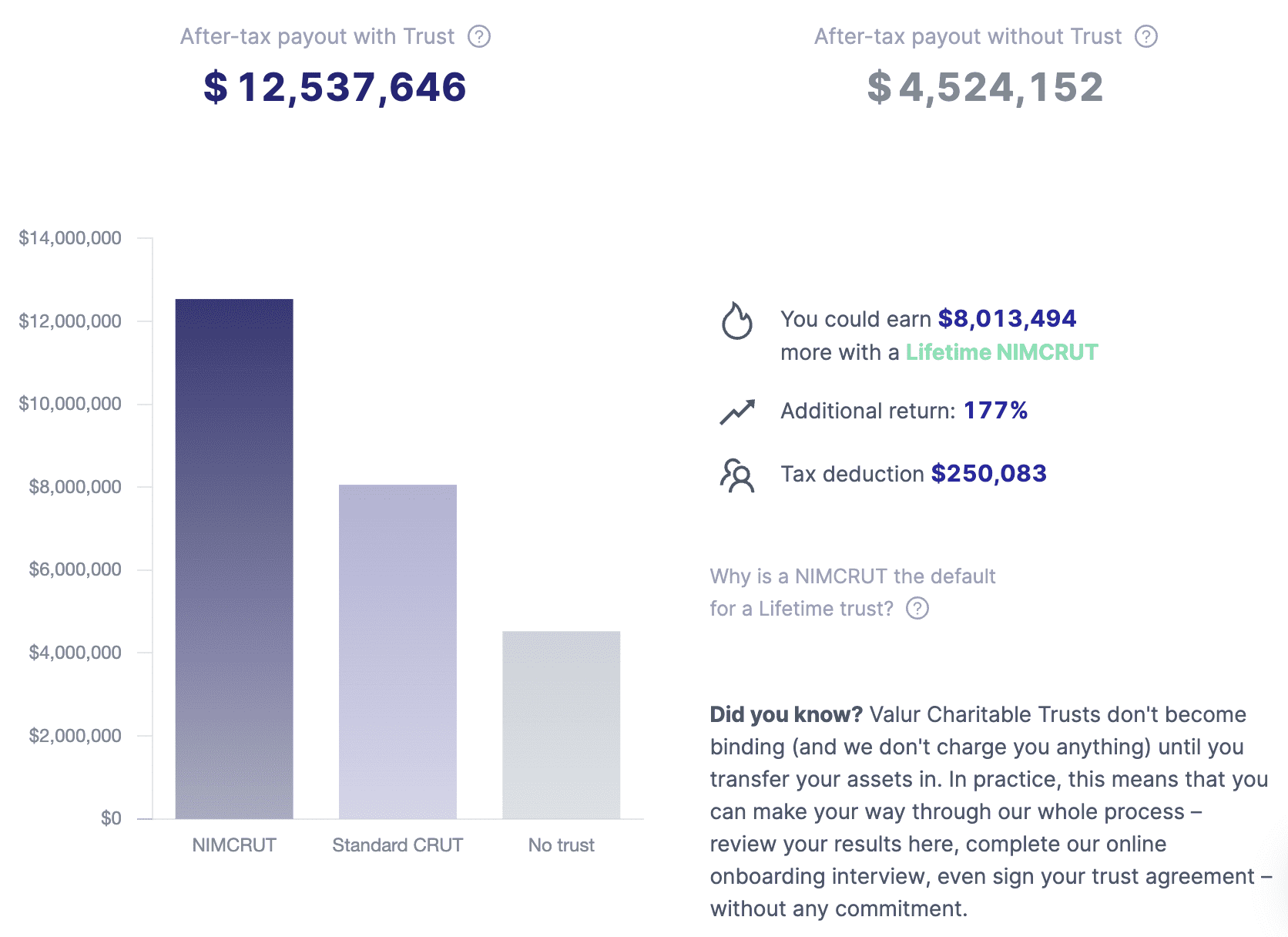
What does all of this mean for Annie’s bottom line? Our calculator projects that over 40 years, taking out about 20% of the trust’s assets every five years, Annie ends up with about $12.5 million in after-tax payouts. That’s nearly triple the $4.5 million she’d have without a trust and more than 50% above what a Standard CRUT would pay her, all while about $5.7 million goes to charity.
In other words, even after a very generous donation to charity, Annie still pockets an extra $8 million, all because she put her shares into a NIMCRUT before she sold them. To see your own potential returns, try our Charitable Remainder Trust calculator.
NIMCRUT Case Study: How Deferring Distributions Affects Your Returns
How much does timing matter? Let’s compare three ways to handle the same $1 million of appreciated assets.
Assumptions
- A 20-year NIMCRUT with an 11% payout rate, funded with $1,000,000 of zero-basis assets
- 11% annual growth, with no dividends or interest
- A 35% combined tax rate on capital gains (e.g., in California or New York City)
- Distributions are reinvested outside the trust at 11%, and all remaining gains are realized and taxed after 20 years
- The upfront tax deduction is left out for simplicity (it would improve both trust scenarios)
Scenario 1: Maximizing Annual NIMCRUT Distributions
At the end of its first year, the trust is worth $1,110,000, so the unitrust amount is $122,100 (11% of the year-end value). The trust has only $110,000 of gains to realize, so it distributes $110,000, and the $12,100 shortfall goes into the makeup account. The trust is worth $1,000,000 again, and every year repeats the pattern.
Each $110,000 distribution is taxed, leaving $71,500 to reinvest. After 20 years:
- Your assets (after taxes): $3,484,327
- Remainder donated to charity: $1,000,000
- Unpaid makeup balance: $242,000
Scenario 2: Leaving the Assets in the Charitable Remainder Trust
Here, the trust realizes no gains, so there’s nothing to distribute, and each year’s entire unitrust amount goes into the makeup account: $122,100 in the first year, $135,531 in the second (11% of $1,232,100), and so on. By the end of the 20th year:
- Trust’s value: $8,062,312
- Total owed to you (20 years of unitrust amounts): $7,839,166
Since the trust is ending, it sells everything and realizes a $7,062,312 gain. That’s less than what it owes you, so the whole gain is distributed to you. After taxes, you’re left with $4,590,502, and $1,000,000 goes to charity.
Scenario 3: Not Using a Trust
Without a trust, you pay the 35% tax when you sell, so you start with $650,000. After 20 years of 11% growth, you have $5,240,502, and after taxes on the appreciation, you’re left with $3,633,827.
How Do These Three Strategies Compare?
After all the taxes are paid, deferring your distributions (Scenario 2) leaves you with about 32% more than taking the maximum every year and about 26% more than not using a trust at all:
| Scenario | Your After-Tax Total | Unpaid Makeup Balance | Charitable Donation |
|---|---|---|---|
| Maximizing annual distributions | $3,484,327 | $242,000 | $1,000,000 |
| Leaving the assets in the trust | $4,590,502 | $776,854 | $1,000,000 |
| Not using a trust | $3,633,827 | N/A | N/A |
The lesson: a NIMCRUT’s edge comes from deferral. The longer your assets grow and are reinvested pre-tax, the larger your returns, and the longer the trust’s term, the wider the gap. Taking the maximum every year gives up that edge, which is why Scenario 1 trails here.
NIMCRUT vs. Standard CRUT: Which Is Better?
Generally, a NIMCRUT is better if you want to maximize your long-term, after-tax wealth and can wait for income, while a Standard CRUT is better if you want predictable cash distributions every year:
- A Standard CRUT pays its fixed percentage every year, no matter what the trust earns, so money leaves the tax-exempt trust on a fixed schedule.
- A NIMCRUT pays only what the trust earns, up to that percentage, so you control the timing to defer taxes longer and invest more money to increase your wealth.
- A Flip CRUT starts as a NIMCRUT and converts to a Standard CRUT after a triggering event, like the sale of an illiquid asset, making it the usual choice for a CRT for real estate.
For a side-by-side look at all three structures, see our comparison of the types of CRUT.
What Are the Downsides of a NIMCRUT?
A NIMCRUT’s flexibility comes with a few trade-offs to keep in mind:
- No income means no distribution. If the trust’s assets fall in value, it may not have enough gains to pay everything it owes you, and any makeup balance still unpaid when the trust ends stays in the trust for charity. You can manage that risk by realizing gains along the way instead of waiting for the final year.
- It’s irrevocable. Once you fund the trust, you can’t take the assets back or change the payout rate, and the remainder must go to charity.
- Administration is more involved. Beyond annual valuations and filing Form 5227, the trustee has to track trust accounting income and the makeup account every year, which adds to CRT administration costs with a traditional provider.
NIMCRUT FAQs
What Does NIMCRUT Stand For?
NIMCRUT stands for Net Income with Makeup Charitable Remainder Unitrust. By definition, a NIMCRUT is a Charitable Remainder Unitrust that pays the lesser of its fixed percentage or its net income each year and makes up any shortfall in later years. A NICRUT is the same trust without the makeup provision, which is why it’s rarely used.
How Are NIMCRUT Distributions Taxed?
NIMCRUT distributions are taxed the same way as distributions from any other Charitable Remainder Trust. According to the IRS, payments are taxed in a set order: ordinary income first, then capital gains, then other income (e.g., tax-exempt income), and finally a tax-free return of principal. The net-income rule only determines how much you’re paid; our guide to how CRUT distributions are taxed walks through the tiers.
Can You Be the Trustee of Your Own NIMCRUT?
Yes, you can generally be the trustee of your own NIMCRUT, which lets you (or your advisor) decide how the trust invests and when it sells. If the trust holds hard-to-value assets, such as private stock, it needs an independent trustee or a qualified appraisal to value them.
Next Steps: Is a NIMCRUT Right for You?
Everyone’s circumstances are different, but a NIMCRUT can be a great fit if you’re willing to give up predictable, consistent payouts in pursuit of greater long-term returns.
With Valur, you can set up a NIMCRUT with no upfront setup cost, typically in one business day, compared with $10,000–$25,000 and six or more weeks with a traditional attorney. We handle the design, setup, makeup-account tracking, and annual tax filings for you, with transparent pricing. To see what a NIMCRUT could mean for you or your clients, schedule a call with our team!
About Valur
We’ve built a platform that makes advanced tax planning—once reserved for ultra-high-net-worth individuals—accessible to everyone. With Valur, you can reduce your taxes by six figures or more, at less than half the cost of traditional providers.
From selecting the right strategy to handling setup, administration, and ongoing optimization, we take care of the hard work so you don’t have to. The results speak for themselves: our customers have generated over $3 billion in additional wealth through our platform.
Want to see what Valur can do for you or your clients? Explore our Learning Center, use our online calculators to estimate your potential savings, or schedule a time to chat with us today!
Reduce your tax bill — fast
Our team of experts will help you evaluate the most promising strategies in minutes.
Talk to our expert team
Valur
Most Promising Fintech Companies 2024

On this page
- How a Net Income with Makeup Charitable Remainder Unitrust Lets You Defer Taxes and Grow Your Wealth
- Key Takeaways
- What Is a NIMCRUT?
- How Does a NIMCRUT Work?
- CRUT vs. No Trust: Wealth Impact Calculator
- What Are the Benefits of a NIMCRUT?
- When Does a NIMCRUT Make Sense?
- NIMCRUT Example: How Annie Defers Taxes on $2.5 Million of Startup Stock
- NIMCRUT Case Study: How Deferring Distributions Affects Your Returns
- NIMCRUT vs. Standard CRUT: Which Is Better?
- What Are the Downsides of a NIMCRUT?
- NIMCRUT FAQs
- Next Steps: Is a NIMCRUT Right for You?
- About Valur





Ready to reduce your capital gains tax?
Free 15-min consult · No obligation · Capital Gains