



Charitable Lead Annuity Trust (CLAT): A Comprehensive Guide

A Charitable Lead Annuity Trust (CLAT) is one of the two types of charitable lead trusts. A charitable lead trust is a trust that names a charity as the initial beneficiary and then names a non-charitable beneficiary (like the donor or the donor’s family member) as the beneficiary when the initial term ends. CLATs pay the charitable beneficiary a fixed “annuity” amount each year — hence the “A” in “CLAT.” CLATs are popular because they allow a donor to support charity while also retaining an interest in the donated asset for themselves or a family member. The CLAT appeals the most to people who (a) are charitably inclined, (b) want a large income tax deduction, and (c) would like to pass wealth to their children, nieces and nephews, or other family members in a tax-efficient way. The CLAT is simultaneously an income-tax strategy and an estate-tax strategy.
With a CLAT, a donor can put an asset in trust and receive a deduction equal to 100% of the asset’s value. The trust will make annual distributions to charity for a specified period of time (often between 20 and 30 years). At the end of the term, the remaining principal will either revert to the donor or pass to the donor’s chosen family member(s). Structurally, the CLAT is very similar to its cousin, the Grantor Retained Annuity Trust (GRAT), but the annual annuity payments are made to charity rather than the donor.
CLTs vs. CRTs
In many ways, a charitable lead trust (CLT) can be understood in direct contrast to Charitable Remainder Trusts (CRTs). CLTs and CRTs are two common types of “split-interest trust” — that is, a trust that benefits both charitable and non-charitable beneficiaries. With a CRT, the grantor places assets into a trust, invests tax free, receives distributions during the term of the trust, and then distributes what’s left at the end to charity. With a CLAT, by contrast, the grantor places money into the trust, receives an up-front tax deduction, makes a donation to charity every year of the trust’s term, and then the donor or another designated beneficiary receives the remainder of the assets after the final charitable contribution.
How Do CLATs Work?

Here’s how CLATs work in greater detail:
Tax Benefits of CLATs
CLATs have two key tax benefits:
The Downsides of CLATs
A CLAT Example
Jeff, a lawyer who lives in Manhattan, started trading crypto a few years ago and has had a good couple of years. He decided to take some of his gains off the table — about $300,000 — but didn’t realize that they would all qualify as short-term capital gains. After accounting for his $500,000 of W-2 income, he’s looking at a close to $400,000 tax bill for this calendar year.
The good news is that Jeff can use a CLAT. By pursuing this strategy:
- Jeff will get to deduct 100% of the current value of the assets he puts into the trust and reinvest the tax savings. In this case, that’s a $300,000 deduction that translates into immediate tax savings this year of about $150,000.
- Jeff will get to support his favorite charity in a big way.
- Jeff, by naming himself as the beneficiary of the CLAT, will get to retain any investment returns inside the CLAT in excess of the IRS hurdle rate (likely around 4% IRR).
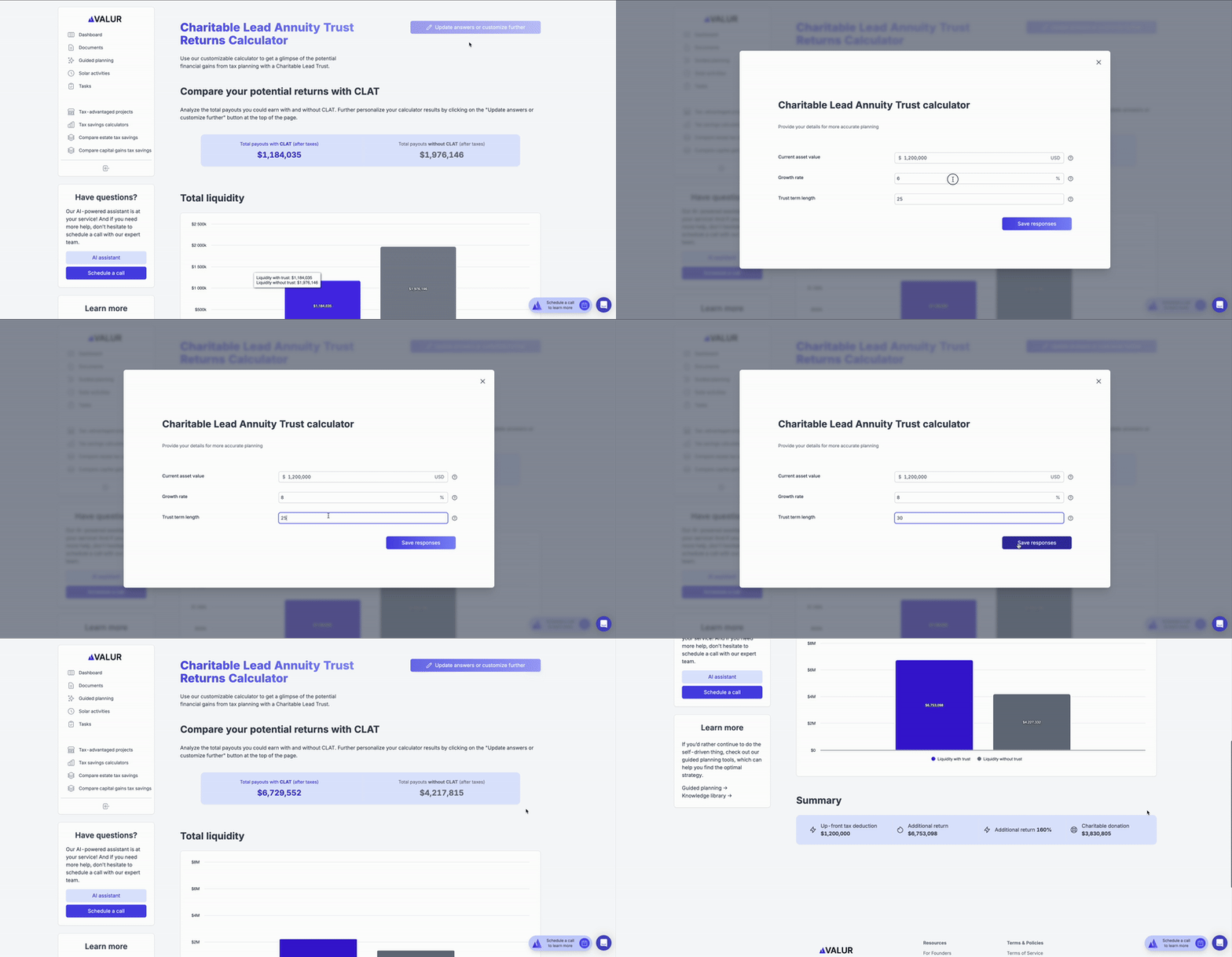
What would these tax savings, investment gains, and donations mean for Jeff’s bottom line? After 25 years of approximately 8% growth, Jeff expects to end up with about $1.3 million in total payouts. Nearly $360k will go to the charity of his choice — that’s the bargain he struck when he chose a Charitable Lead Annuity Trust — so he will end up with about $971,000 in his pocket.
If, instead, Jeff had paid his taxes up front and reinvested the remainder — about $150,000 — in a regular, taxable investment account, he would have ended up with about $761,000 after taxes.
Are you having more questions about CLATs? Check out our case study on reducing your ordinary income with a CLAT or, estimate your own potential returns with our easy to use calculator.
Related Readings
- A Charitable Lead Trust Example to Defer Taxes
- CLAT Option Exercise to Reduce Your Tax Bill
- Tax Deferral With A Charitable Lead Trust
About Valur
We’ve built a platform that makes advanced tax planning – once reserved for ultra-high-net-worth individuals – accessible to everyone. With Valur, you can reduce your taxes by six figures or more, at less than half the cost of traditional providers.
From selecting the right strategy to handling setup, administration, and ongoing optimization, we take care of the hard work so you don’t have to. The results speak for themselves: our customers have generated over $3 billion in additional wealth through our platform.
Want to see what Valur can do for you or your clients? Explore our Learning Center, use our online calculators to estimate your potential savings or schedule a time to chat with us today!
Reduce your tax bill — fast
Our team of experts will help you evaluate the most promising strategies in minutes.
Talk to our expert team
Valur
Most Promising Fintech Companies 2024



Ready to reduce your capital gains tax?
Free 15-min consult · No obligation · Capital Gains