



The Ultimate Guide to Spousal Lifetime Access Non-Grantor Trusts (SLANTs)
In the world of tax planning, you are often forced to choose between three competing desires:
- Estate Tax Efficiency: You want to move assets out of your estate to avoid estate taxes.
- State Tax Efficiency: Move assets out of the tax jurisdiction of high tax states like California and New York to avoid state income taxes which are up to 13%.
- Financial Security: You are afraid of giving away your wealth and losing access to the proceeds forever.
Enter the SLANT (Spousal Lifetime Access Non-Grantor Trust) which is able to (mostly) solve all three of these issues.. But first let’s start with the basics of what estate taxes are and why people use dynasty trusts like SLANT’s to minimize estate taxes.
The Wealth Transfer Taxes: Gift, Estate & Generation Skipping Transfer Taxes
The Federal Estate Tax
The gift tax and the estate tax are functionally a single tax: the gift tax applies to lifetime gifts and the estate tax applies to transfers upon death (and they use the same exemption amount). The estate tax is a tax on the assets that a person leaves to their heirs when they pass away. The estates of U.S. citizens and residents are taxed on all of their worldwide assets — including real estate, retirement accounts, brokerage accounts, crypto, intellectual property, and whatever else a person owns. The federal estate tax rate is a flat 40%, and any tax is due within nine months of a person’s death.
There are three important exceptions to the estate tax.
First, each individual has a basic exclusion amount, sometimes called a lifetime exemption. The exemption is large; it’s the reason most Americans never owe any estate tax. In 2026, the exemption is $15 million.
Second, amounts left to a person’s U.S. spouse are not taxed. This prevents a surviving spouse from having to sell the family home or business to pay estate tax. However, when the surviving spouse dies, his or her estate (including the amount inherited from the deceased spouse) will be subject to estate tax.
Third, amounts left to charity are not taxed. Warren Buffett says he plans to leave the vast majority of his fortune to charity when he dies. That means that Buffett’s estate won’t be subject to much estate tax. Of course, most people want to leave the bulk of their estates to their family members.
It’s hard to overstate how important estate tax planning is for high-net-worth people. The federal estate tax is a serious obstacle to intergenerational wealth transfers. Under current law, the estate of a New Yorker who dies with $30 million in 2026 will owe around $7.5 million of state and federal estate tax. And yet, the estate of a billionaire New Yorker who dies in 2026 after doing careful estate tax planning may owe very little. That’s the power of estate tax planning.
The Federal Gift Tax
The federal gift tax is a tax on gifts made during the gifter’s lifetime. It applies when the transferor is a U.S. citizen or resident. Like the federal estate tax, it is levied at 40%, and it shares the same exemption amount with the estate tax (in 2026, $15 million). So, if you use $3 million of your gift tax exemption during your lifetime and you die in 2025, your remaining estate tax exemption will be $12 million.
The Generation-Skipping Transfer (GST) Tax
The generation-skipping transfer tax also applies to transfers to non-family members who are 37.5 years or more younger than the donor. This tax is also levied at a rate of 40%, which means transfers to your grandchildren could be subject to an effective tax rate far in excess of 50%! Like the gift and estate tax exemption amount, the generation-skipping transfer tax exemption amount is $15 million in 2026.
Let’s assume you have used your full lifetime gift and GST exemption of $15 million and have $10 million that you want to gift to your heirs. If you directly give that amount to your children, it will be subject to a 40% estate tax, leaving $6 million for your kids. If, instead, you gift that $10 million to your grandkids, it will be subject to a 40% estate tax and a 40% GST tax, leaving only $3.6 million for your grandkids! Fortunately, with Valur’s help you should be able to avoid most (or all) of these transfer taxes.
What is a SLANT?
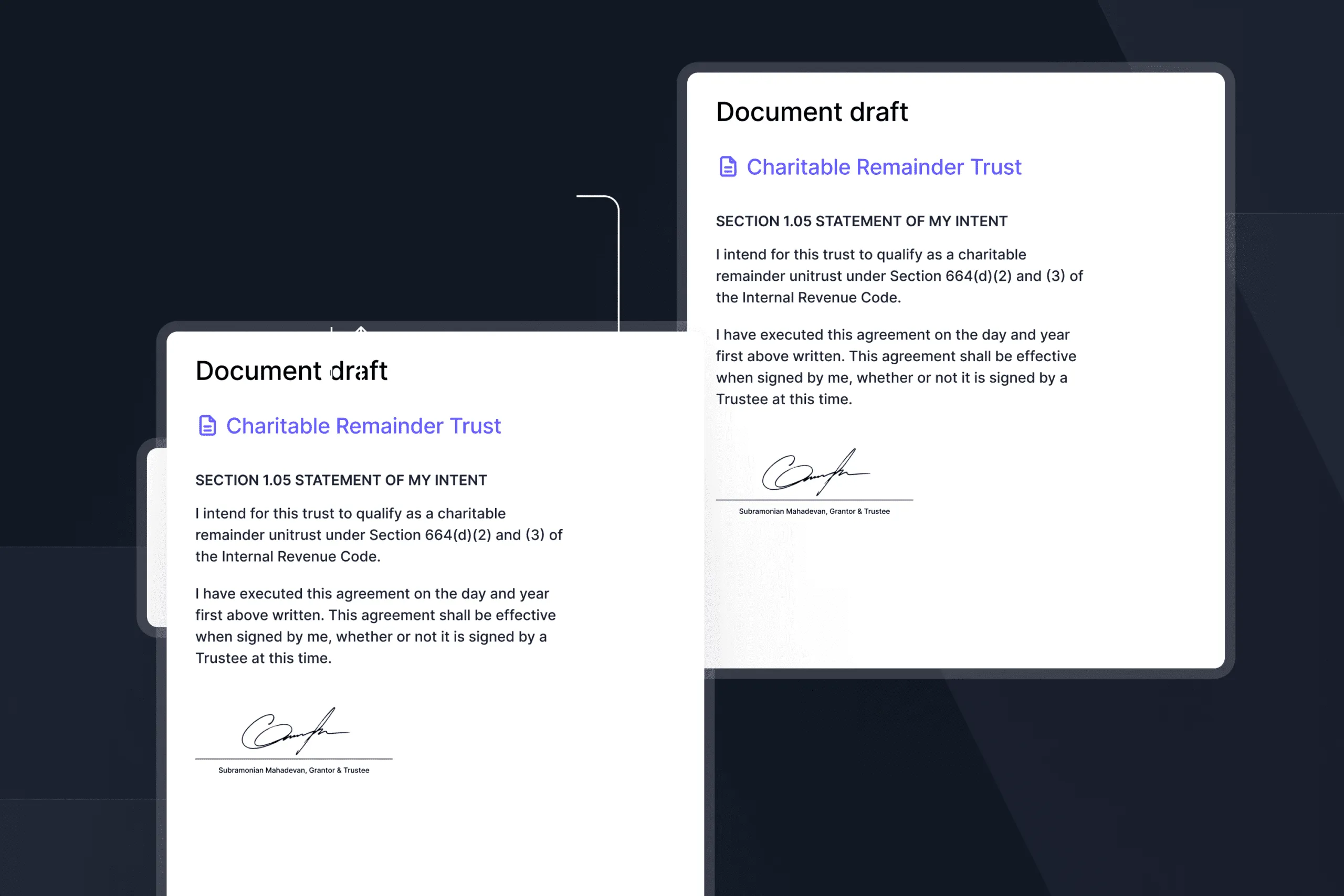
A Spousal Lifetime Access Non-Grantor Trust (SLANT) is an irrevocable trust strategy designed to move assets out of a grantor’s taxable estate while still allowing their spouse to benefit from those assets. In this structure, one spouse (the grantor) gifts assets into the trust for the benefit of the other spouse (the beneficiary) and their future descendants (children and grandchildren). Because the trust is irrevocable, the assets are generally protected from creditors and are not counted toward the grantor’s estate for estate tax purposes, effectively freezing the value of the assets at the time of transfer and allowing future appreciation to grow tax-free outside the estate. It is also helpful if you read this overview of SLAT’s for proper context and to understand how these are different.
The Distinction in Plain English:
- In a Standard SLAT (Grantor Trust), you move assets out of your estate, but you still pay all the income taxes on those assets personally.
- In a SLANT (Non-Grantor Trust), the trust pays its own taxes and is its own tax payer which is important for QSBS stacking.
The Estate Tax Freeze
When you fund a SLANT, you are making a “completed gift.” This removes the assets—and, crucially, all future appreciation on those assets—from your taxable estate. By allocating your GST exemption to the trust when you fund it, the assets inside can grow, be distributed to your children, and then pass to your grandchildren (and all future generations) free of estate and GST taxes forever.
- Example: You transfer $5M of pre-IPO stock into a SLANT. If that stock grows to $50M by the time you die, that entire $45M of growth is outside your estate. You have saved your heirs roughly $18 million in federal estate taxes (40% of $45M)and $10.8 million in GST taxes and only used $5m of your lifetime gift and GST exemption. In addition, all the future growth on the $50m will grow free of gift, estate and GST taxes!
The “Why” of SLANTs: Three Core Drivers
Why do people choose a SLANT? The motivation is typically one of the following:
- QSBS Stacking: The ability to claim an additional $10 million QSBS exclusion on the sale of startup stock is one biggest driver.
- State Tax Arbitrage (+not as worried about estate taxes): For residents of California, New York, or any other high tax state, moving investment assets to a non-grantor trust in South Dakota or Nevada can save 10-13% annually of the investment growth from taxes. If you are worried that even with proper planning you will pay estate taxes,these tax savings won’t be important as state income taxes are less than estate taxes (13% < 40%). But if you have a proper plan in place with Valur, you should be able to avoid estate and state income taxes.
- Income Shifting: A SLANT allows income to be distributed to beneficiaries (e.g., grandchildren or children in lower tax brackets) rather than piling onto the Grantor’s top-bracket return.
The Structural Foundation – SLATs vs. SLANTs
The Standard SLAT: The Default
A Spousal Lifetime Access Trust (SLAT) is an irrevocable trust created by one spouse (the Grantor) for the benefit of the other spouse (the Beneficiary Spouse) and their descendants. The primary goal is estate tax efficiency. The Grantor uses their lifetime gift tax exemption—currently at $15 million per individual starting January 1, 2026 —to transfer assets into the trust.
The standard SLAT carries a feature that, depending on one’s perspective, is either a bug or a feature: it is a Grantor Trust for income tax purposes. This means the grantor continues to pay the income taxes on the trust’s earnings. This creates a powerful “tax burn”—allowing the trust to grow tax-free while reducing the grantor’s taxable estate as the grantor pays the trust taxes. It can be a bug for maximizing specific opportunities, most notably QSBS stacking and for families in high tax states who want to avoid state income taxes in jurisdictions like California and New York. Families often choose SLAT’s when they are significantly over the estate tax and the estate and GST tax liability is a bigger concern that state taxes or QSBS stacking.
- The Benefit: The trust grows income-tax-free, compounding faster. The Grantor (i.e. you) being able to cover the trust’s tax payments are effectively additional, tax-free gifts to the trust.
- The Limitation: The trust is not a separate taxpayer. It cannot claim its own QSBS exclusion. It cannot shield income from the Grantor’s state income tax if the Grantor lives in a high-tax state.
So how is a Spousal Lifetime Access Non-Grantor Trust (SLANT) able to avoid being a grantor trust?.
The SLANT “Magic” Trick: The Adverse Party
Usually, if your spouse is a beneficiary, the IRS automatically treats the trust’s income as yours. To break this link and turn the trust into a Non-Grantor Trust (a separate taxpayer), the SLANT utilizes the Adverse Party rule.
The trust is drafted so that distributions to your spouse can only be made with the consent of an “Adverse Party”—typically another beneficiary (like an adult child or one of the spouse’s siblings) whose interest in the trust would be reduced if money were distributed to your spouse. Because this person has a financial incentive not to approve the distribution, the IRS respects the trust as a separate entity.
Table 1: SLAT vs. SLANT Feature Comparison
| Feature | Standard SLAT | SLANT |
| Income Tax Payer | The Grantor (Individual) | The Trust (Separate Entity) |
| Estate Tax Status | Completed Gift (Assets Removed) | Completed Gift (Assets Removed) |
| Access to Funds | Spouse (Discretion of Trustee) | Spouse (Consent of Adverse Party) |
| QSBS Exclusion (Sec. 1202) | No additional exclusion | Separate Exclusion ($10M+ Cap) |
| State Income Tax | Taxed at Grantor’s Rate | Potential for 0% |
| Administrative Burden | Low (No separate return usually) | High (Form 1041, K-1s, Consents) |
xThe Mechanics of the “Adverse Party”
The entire validity of a SLANT structure rests on a single definition in the tax code: the Adverse Party. Understanding this concept is not just for the lawyers; it is critical for the family to understand the interpersonal dynamic they are creating.
Identifying the Right Adverse Party
Selecting the adverse party is the most delicate decision in SLANT drafting.
- The Ideal Candidate: An adult child of the Grantor who is a primary remainder beneficiary. This person has the clearest economic conflict with the current distribution.
- The Problematic Candidate: A sibling of the Grantor or a friend. While they could be beneficiaries, their interest might not be “substantial” enough relative to the whole trust if they are only contingent or minor beneficiaries.
- The “Non-Adverse” Trap: An independent corporate trustee (like a bank) or a family attorney is not an adverse party.
Families must consider the emotional weight of this structure.
- Parent-Child Dynamic: The SLANT effectively gives the child veto power over the parent’s access to funds. In a healthy family with ample outside assets, this is a formality. In a family with tight liquidity or strained relationships, this can create significant friction.
- The “Rubber Stamp” Risk: If the adverse party always says yes without question, the IRS could argue there is an implied agreement that the consent is illusory. Best practices suggest the adverse party should occasionally question or document the reasoning for their consent to demonstrate independent judgment.
Case Studies
To understand the power of the SLANT, let’s examine three distinct scenarios.
Case Study A: The Tech Founder (QSBS Stacking)
Profile: Sarah, founder of a SaaS company in New York.
Asset: $20 million of Founder Stock (Basis $0).
Goal: Sell in 2026. Keep maximum proceeds.
Strategy:
- Sarah retains $10 million of stock.
- Sarah creates a SLANT (South Dakota situs) for her husband and 2 kids. She gifts $10 million of stock to the SLANT.
- The SLANT requires the consent of her eldest son (age 25) for any distributions to her husband.
Outcome upon $20M Sale:
- Sarah (Personal): Claims $10 million Section 1202 exclusion. Tax = $0.
- SLANT (Trust): Claims $10 million Section 1202 exclusion. Tax = $0.
- State Tax: Sarah avoids NY state tax on the personal portion. The SLANT avoids NY state tax entirely because it has no no NY trustees/assets.
- Net Savings: Over $3.5 million in combined federal and state taxes compared to holding personally or in a standard Grantor SLAT (where exclusions are shared).
Case Study B: The California Portfolio (The Freeze)
Profile: Mark and Linda, California residents. Net worth $30 million.
Asset: $10 million hedge fund portfolio.
Goal: Stop paying 13.3% CA tax on portfolio gains and remove growth from estate.
Strategy:
- Mark creates a Nevada SLANT for Linda and kids.
- Transfers the $10 million portfolio.
Outcome:
- Estate Tax: The $10 million and all future growth are out of Mark’s estate.
- Income Tax (Federal): The Trust pays federal tax (Form 1041).
- Income Tax (California):
- Linda is a discretionary beneficiary. The Trust pays no CA tax currently. However, CA tracks the “unpaid” tax. If the trust distributes to Linda while she is in CA, she pays the tax + interest .
- The Win: Mark and Linda plan to retire to Florida in 5 years. Once they move, the trust can distribute the accumulated income. Since they are no longer CA residents, they avoid CA income taxes. The SLANT acted as a tax-deferred savings account.
Case Study C: The Dynasty Builder (Income Shifting)
Profile: Dr. Jones, a surgeon in top tax bracket (37% Fed + State).
Asset: Commercial building generating $200k/year rent.
Goal: Pay for grandchildren’s private school.
Strategy:
- Dr. Jones transfers building to a SLANT.
- Trust generates $200k rent.
- Instead of retaining income (taxed at high trust rates), the Trustee distributes the $200k to the 5 grandchildren (ages 18-22).
- Result: The income is taxed at the grandchildren’s rates (likely 10-12% or 0% if structured as qualified education payments under complex rules).
- Adverse Party: Dr. Jones’s son consents to the distributions (he is happy because his kids’ tuition is being paid).
About Valur
We’ve built a platform that makes advanced tax planning – once reserved for ultra-high-net-worth individuals – accessible to everyone. With Valur, you can reduce your taxes by six figures or more, at less than half the cost of traditional providers.
From selecting the right strategy to handling setup, administration, and ongoing optimization, we take care of the hard work so you don’t have to. The results speak for themselves: our customers have generated over $3 billion in additional wealth through our platform.
Want to see what Valur can do for you or your clients? Explore our Learning Center, use our online calculators to estimate your potential savings or schedule a time to chat with us today!
Reduce your tax bill — fast
Our team of experts will help you evaluate the most promising strategies in minutes.
Talk to our expert team
Valur
Most Promising Fintech Companies 2024






Ready to talk through your options?
Free 15-min consult · No obligation · Estate Tax